

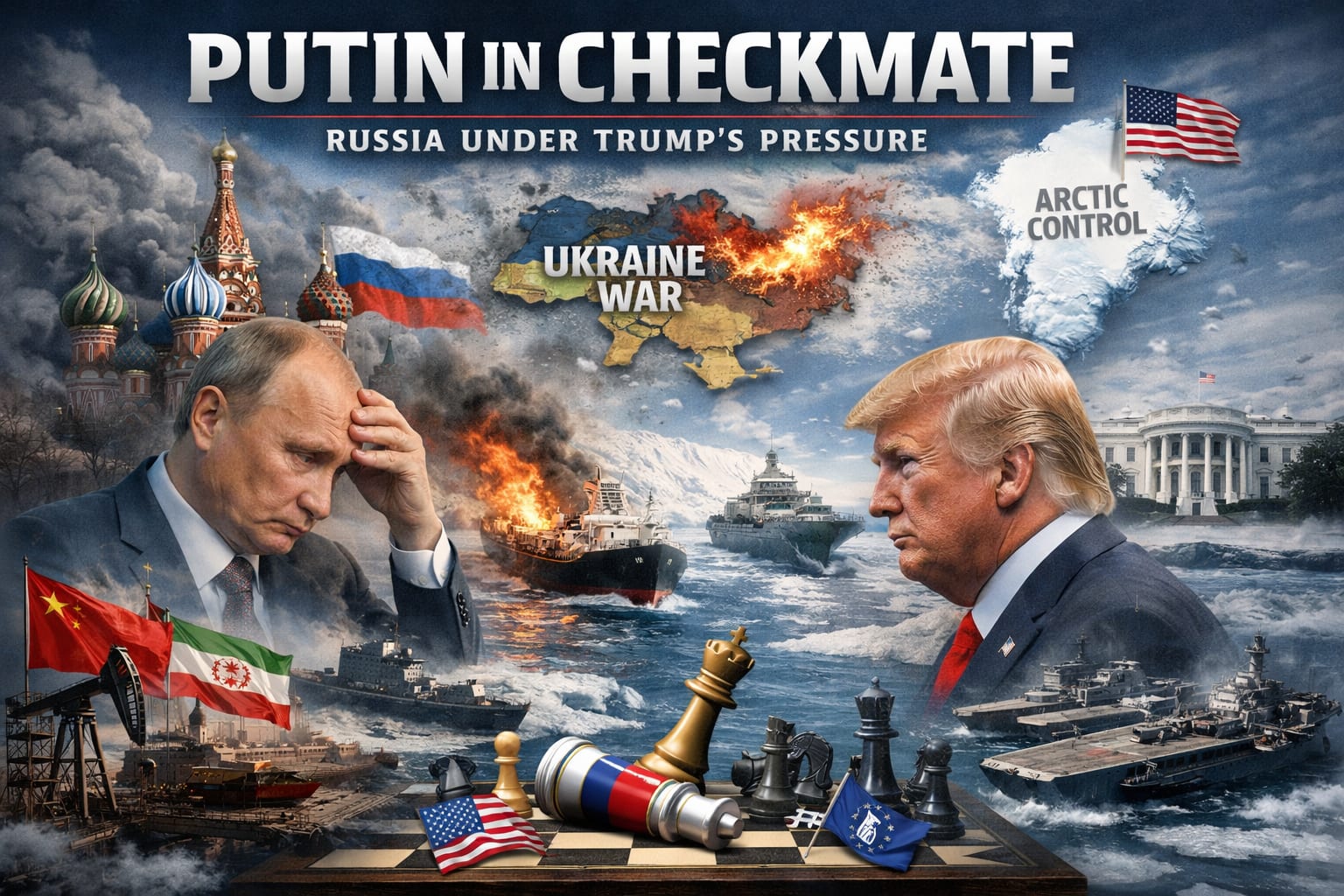
Over the past weeks, a dramatic escalation in U.S. strategic actions — from seizing sanctioned oil tankers tied to Russia and Venezuela to an unprecedented military intervention in Caracas — has spotlighted a deeper shift in American foreign policy. These moves are not isolated flare-ups; they reflect a coherent worldview that now appears in the Trump administration’s 2025 National Security Strategy (NSS). According to the NSS, the U.S. will focus on protecting core national interests, strengthening economic and energy security, and asserting regional dominance in the Western Hemisphere, all while navigating a world transitioning toward multiple centers of power rather than unipolar control by any single world order.
1. A New Geopolitical Playbook: Multipolar But America First
Unlike recent post–Cold War strategies, the Trump NSS rejects an expansive global footprint and instead stresses sovereignty, economic power, and a narrowed definition of national interest. Rather than deep integration with traditional alliances, the strategy pivots toward America First realism, emphasizing economic strength and deterrence while cautiously engaging with emerging power centers.
Under this rubric, Washington is not retreating from global influence, but reordering it on U.S. terms, especially in the Western Hemisphere. The NSS borrows from — and expands — the Monroe Doctrine, asserting that hostile great powers should not entrench themselves in America’s backyard. This doctrine now drives strategic action against China, Russia, Iran, and their proxies in Latin America, particularly Venezuela.
2. Energy Security as National Security
A central pillar of the 2025 strategy is recognizing that energy markets are as critical to national security as military power. The Trump administration has moved aggressively to control global oil flows tied to sanctioned states, with the aim of degrading adversaries’ influence and bolstering U.S. leverage. This has manifested most visibly in seizing sanctioned tankers at sea, including vessels reflagged under Russian colors while transporting Venezuelan crude — a direct challenge to Russia’s shadow fleet and attempts to evade sanctions.
In this context, the U.S. isn’t just enforcing sanctions for their own sake. It is actively reallocating the flow of energy resources — pulling them away from Russia, China, and Iran, and placing them under U.S. economic control. The strategy views this as an extension of national power: control of oil equals control of economic influence on a global scale.
3. The Venezuela Gambit: Proxy Pressure on Russia and China
The January 3, 2026 U.S. operation that captured Venezuela’s President Nicolás Maduro was a watershed moment. This intervention, largely pushed by the Trump administration, has been widely interpreted as a demonstration of American resolve to deny footholds in the Western Hemisphere to rival powers. Observers describe this as part of a “Trump Corollary” — a 21st-century Monroe Doctrine designed to block entrenched influence from China and Russia in the Americas.
Venezuela was one of China and Russia’s most important energy partners. By wresting control of Venezuelan oil and integrating it into U.S. markets, Washington disrupts Beijing’s discounted oil supply chains and closes a crucial economic lifeline for both China and Moscow. Analysts note that Washington’s actions “jeopardize the flow of discounted Venezuelan oil to China’s teapot refineries” and challenge Chinese and Russian energy strategies in tandem.
4. Russia’s Strategic Dilemma: Cornered and Constrained
For President Vladimir Putin, this strategic environment presents a profound challenge. Traditionally, Russia has leveraged energy exports — particularly to China — and geopolitical influence in Latin America to project power and bypass Western pressure. But recent developments under the Trump NSS threaten that model:
-
The United States is enforcing sanctions more assertively, targeting the so-called shadow fleet of tankers used to evade international restrictions on Russian oil exports.
-
U.S. control over Venezuelan oil supplies has disrupted a key Russian ally, undercutting Moscow’s ability to maintain energy export networks independent of Western influence.
-
The broader shift toward Western Hemisphere dominance signals that Moscow’s traditional arenas of influence are shrinking.
Putin’s options are narrowing. Escalating militarily against the U.S. or NATO carries enormous risk; Russia’s capacity for a sustained confrontation with U.S. military assets is limited, particularly while an expensive campaign in Ukraine continues. Moreover, continued proxy energy partnerships with China and Iran are under increasing strain due to U.S. pressure, logistical chokepoints, and international economic isolation.
5. A Multipolar World on American Terms
While the Trump NSS ostensibly accepts a multipolar world, it seeks to shape that world so American interests remain central. Instead of pursuing ideological or military dominance, the strategy uses economic leverage, energy controls, and regional influence as tools of power. This means:
-
Redefining spheres of influence, particularly in the Western Hemisphere.
-
Using energy markets as instruments of geopolitical control.
-
Isolating rival powers by severing their proxy networks.
In effect, Washington’s policy aims to fragment alliances that challenge U.S. primacy, forcing countries like Russia and China into less advantageous positions. This is not a pursuit of global domination — it’s strategic containment through economic and geopolitical architecture.
Conclusion: Checkmate or Transition?
In this emerging world order, Russia is not annihilated, but it faces severe structural constraints. Through an aggressive combination of economic pressure, naval interdiction, and strategic intervention, the United States under the Trump NSS appears to have placed Putin in a position with few good options left: submit to a new geopolitical alignment focused on U.S. core security interests, or risk deeper conflict with a far more powerful adversary.
Whether this is truly “checkmate” or a transitional realignment will depend on how both sides adapt to a world where traditional power plays are increasingly vulnerable to targeted, economically grounded strategy — and where control of energy and supply flows may be the ultimate currency of power.
