

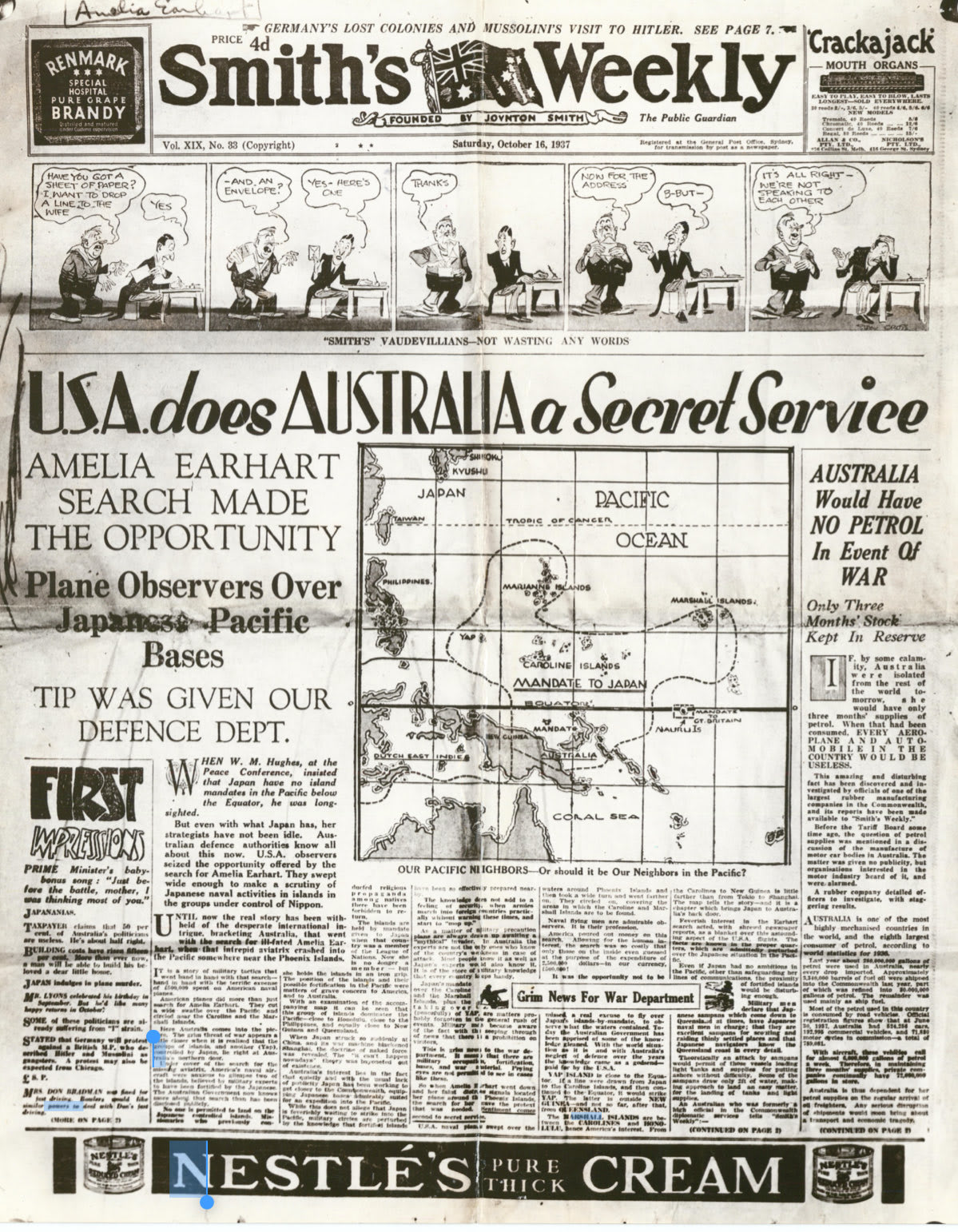
The Declassified Files Don’t Tell a Story — They Hide One.
For decades, we’ve been told Amelia Earhart simply got lost, ran out of fuel, and vanished somewhere in the empty Pacific.
A tragic accident. Nothing more.
But after reviewing the newly declassified documents, I can say this confidently:
These files don’t explain her disappearance. They obscure it.
Not in a Hollywood way — but in the unmistakable bureaucratic way a government hides something it cannot publicly admit.
Not one document tells a coherent story.
Not one explanation is grounded in certainty.
Not one investigative thread leads anywhere.
The archives read like a mosaic of “we don’t know,” “not our department,” and “check the historical records.”
It’s not a trail of evidence.
It’s a trail of avoidance.
And when you put all this together — plus what we know about 1937 U.S.–Japan tensions — one conclusion becomes unavoidable:
Amelia Earhart was almost certainly shot down by the Japanese… and the United States covered it up because it was not prepared to fight a war in the Pacific.
Let me walk you through why I make this assessment.
The Declassified Files Are Not Evidence — They’re a Shield
The first thing that struck me reading the declassified material is this:
These documents were NOT classified because of what they contained.
They were classified because of what they covered up.
Understanding this requires knowing something crucial about the era:
In 1937, U.S. classification systems barely existed.
There was no unified system.
No standardized procedure.
No “Top Secret / Secret / Confidential” structure we recognize today.
Instead, agencies kept their own notes, letters, transcripts, internal memos…
Then after Pearl Harbor and WWII, these older stacks of sensitive material were simply retroactively classified.
When you look at the Earhart files through THAT lens, the picture changes dramatically.
The documents themselves are mundane.
The classification was not.
Why classify a bunch of “I don’t know” memos?
Because the absence of information is itself the tell.
This wasn’t confusion.
It was compartmentalization.
A deliberate ignorance.
A bureaucratic firewall.
The Kimmel Note: The Smoking Gun of Non-Answers
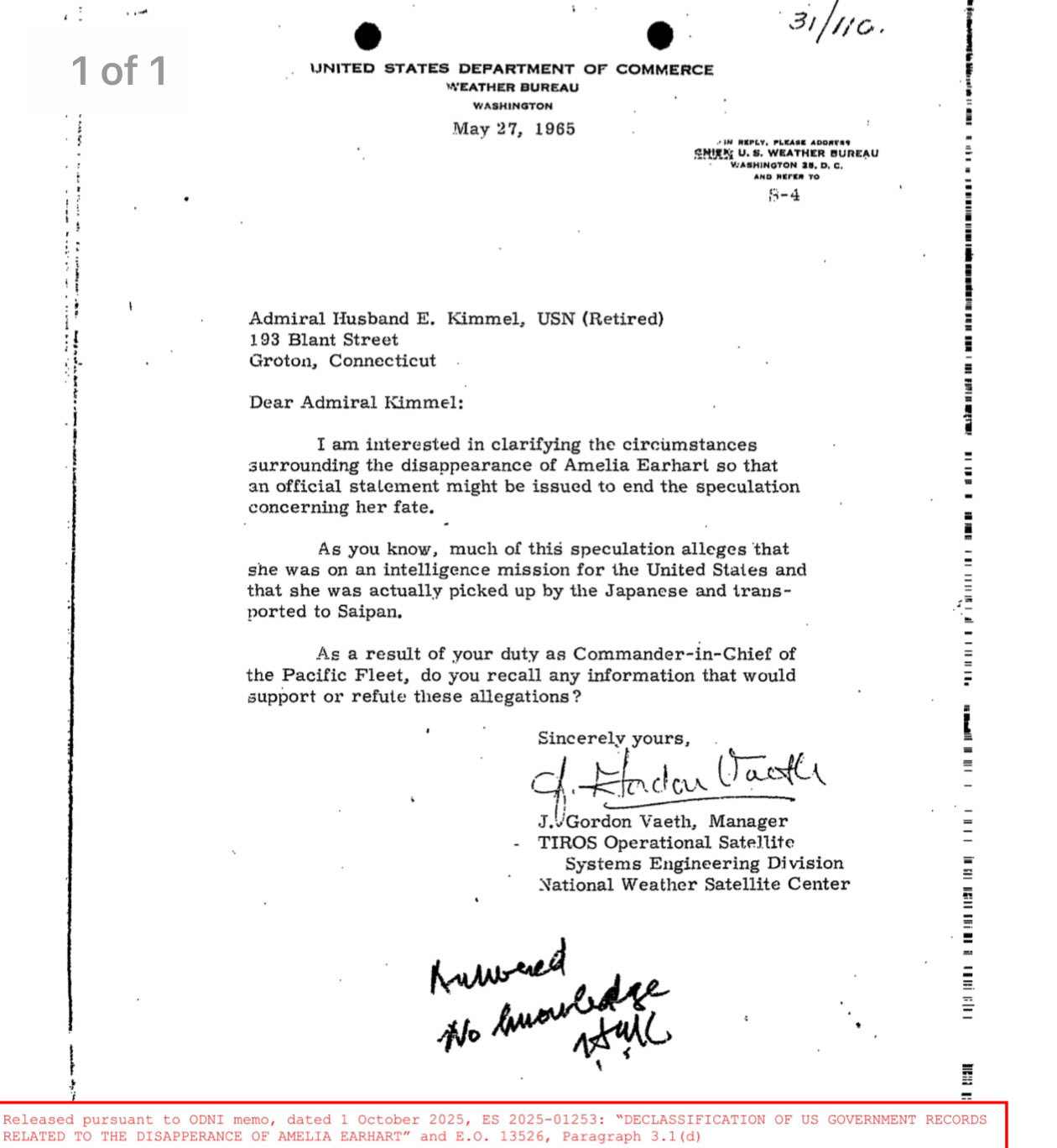
The clearest example is the correspondence to Admiral Husband Kimmel, commander of the U.S. Pacific Fleet.
One note stands out:
Handwritten: “No knowledge.”
Typed memo: “Check historical records.”
Followed by a chain of agencies — all saying they have nothing.
This is not normal.
A massive naval search had been conducted.
Aircraft carriers deployed.
Destroyers dispatched.
Radio operators combing frequencies day and night.
Yet EVERY agency claims they have “nothing.”
No conclusions.
No data.
No analysis.
No final record.
That is statistically impossible.
Unless the truth was not distributed across agencies.
Unless it was contained in a very small circle.
Unless someone shut the door.
The Kimmel correspondence isn’t evidence of ignorance.
It’s evidence of intentional absence.
A void created on purpose.
The Denied Diplomatic Request — The Most Important Fact No One Talks About
This part is not speculation.
This is documented:
Amelia Earhart requested diplomatic permission to fly over Japanese territory.
Japan denied it.
She was not permitted to fly over the Mandated Islands — a region Japan was secretly militarizing.
This is the first red flag.
You don’t deny overflight to a peaceful aviator unless:
-
You’re hiding something.
-
You’re building something.
-
Or you’re prepared to defend that secret militarily.
Japan, in 1937, was doing all three.
Earhart was warned.
The State Department was warned.
Yet her flight path put her dangerously close to Japanese-controlled waters.
That’s not an accident.
That’s a recipe for disaster.
She Was NOT Flying Toward Howland — She Was Flying Toward Japan’s Perimeter
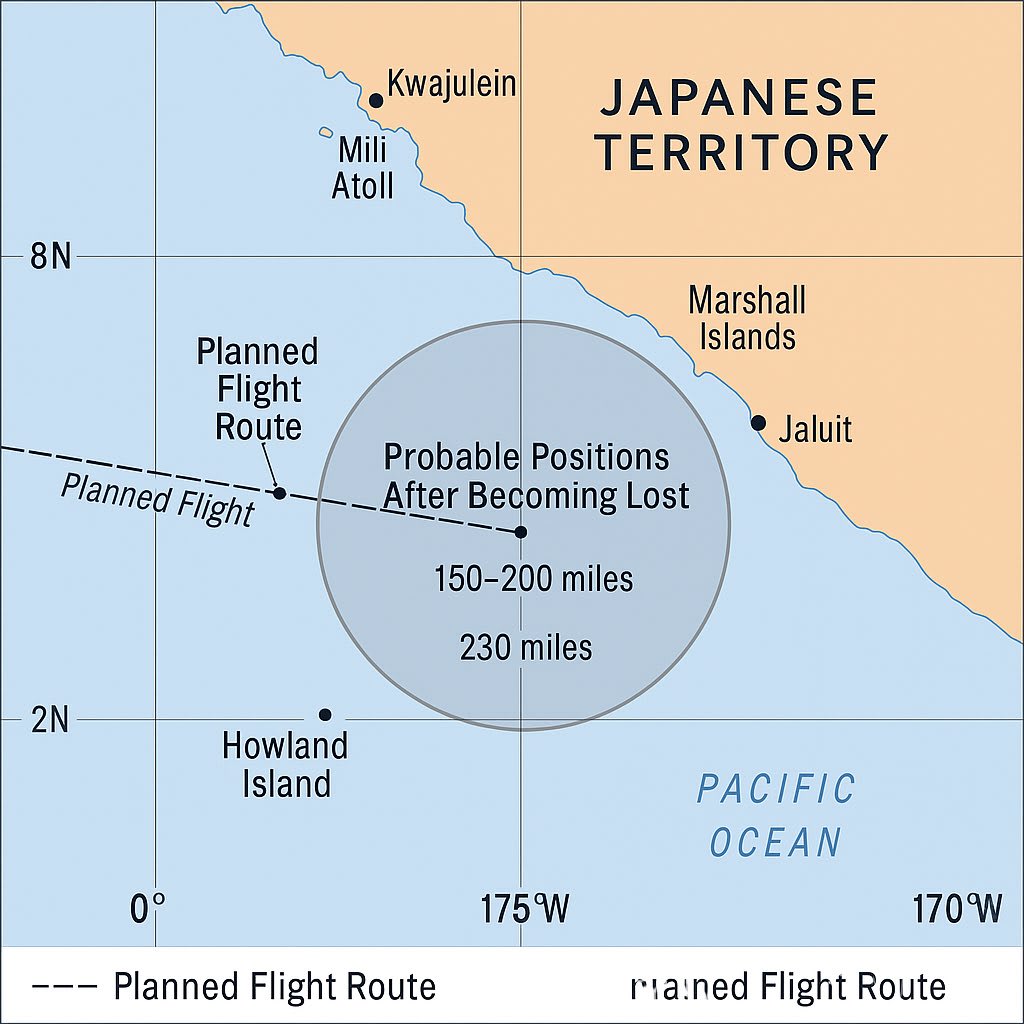
Let’s kill the biggest misconception.
Earhart’s final leg was:
Lae, New Guinea → Howland Island.
But if she missed Howland by even a few miles — which her final radio transmissions suggest she did — the only land she could possibly reach was:
Japanese territory.
And in 1937, those islands were:
-
Militarized
-
Fortified
-
Closed to foreigners
-
Patrolled by Japanese naval forces
-
Hostile to unauthorized reconnaissance
Her margin for error wasn’t narrow.
It was zero.
Her Final Transmission Is the Most Damning Piece of Evidence
The last confirmed message:
“We are on the line 157–337. We are running north and south.”
07:42 AM local time
This is classic distress language from a pilot who has reached the destination point but cannot find the island.
It means:
-
She believed she was OVER Howland
-
But Howland was not visible
-
She began flying the search line north–south
-
She was now in survival mode
And here’s the key:
Flying “north” on that line takes you toward nothing but empty ocean.
Flying “south” takes you directly toward Japanese territory.
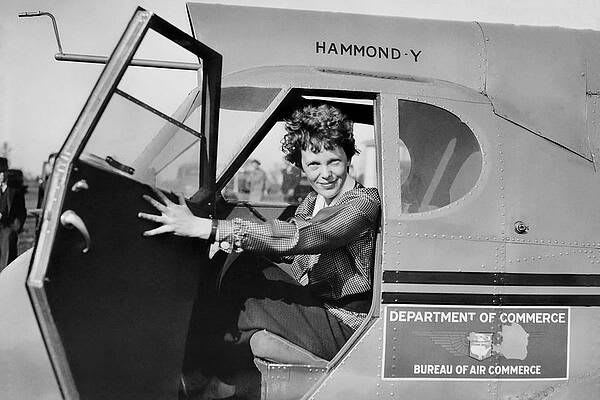
Now the timeline matters.
Her fuel estimate indicates she could have flown south on that line long enough to place her squarely within the Japanese naval patrol perimeter.
If you plot her theoretical glide path based on wind correction errors and last-known coordinates…
She ends up frighteningly close to Mili Atoll, Jaluit, and Japanese naval operating zones.
Exactly where multiple islander eyewitnesses later claimed a plane crash-landed.
Exactly where Japanese records are mysteriously silent.
Exactly where the U.S. Navy did NOT conduct a thorough search — despite searching thousands of miles elsewhere.
Strange, isn’t it?
The Japanese Were Militarizing That Region — Aggressively
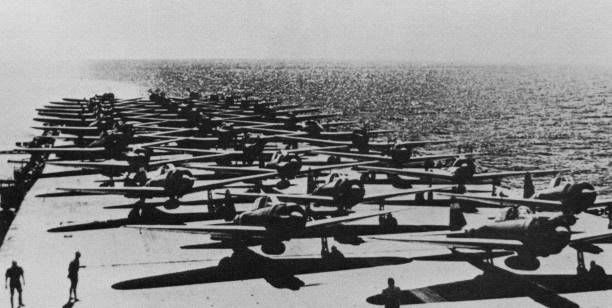
Japan was building:
-
Airfields
-
Seaplane bases
-
Naval stations
-
Communication outposts
-
Anti-aircraft placements
All in violation of the Mandate rules.
This was the secret foundation of their Pacific assault strategy — the same islands used to launch attacks in 1941–42.
They were paranoid, protective, and prepared to use force against ANY aircraft approaching these zones.
Foreigners were forbidden.
Photography was forbidden.
Navigation near these islands was forbidden.
And Earhart — intentionally or not — approached them.
Japan would not have asked questions.
They would have shot first.
Japan’s Postwar “Denial” Means Nothing
After WWII, Japan claimed they had nothing to do with Earhart.
Of course they did.
The same Japanese military that was burning documents in barrels before surrender…
The same military that hid atrocities…
The same military that denied the Rape of Nanking…
The same military that lied about POWs…
…was suddenly telling the truth about Amelia Earhart?
Give me a break.
This denial means absolutely nothing.
If Earhart was:
-
shot down,
-
forced down,
-
captured,
-
or killed,
the Japanese Navy would bury that truth so deep that not even postwar interrogations could pull it out.
Saving face is a cultural imperative — especially after losing a war.
Their denial is the least credible piece of the entire puzzle.
Whether She Was Spying or Not — The Most Plausible Scenario Is Simple
Let’s set aside the espionage question for a moment.
Whether Earhart was spying for the U.S. or not…
The evidence overwhelmingly points to this:
She entered Japanese-controlled airspace, was detected, intercepted, and shot down or forced down.
That’s the cleanest explanation.
It aligns with:
-
Geography
-
Radio logs
-
Fuel calculations
-
Japanese naval patrol radiuses
-
Eyewitness accounts
-
Declassified U.S. documents
-
The timing of regional militarization
And it explains PERFECTLY why the U.S. buried everything.
The Real Reason for the Cover-Up: The U.S. Wasn’t Ready to Fight Japan
This is the part no one says out loud.
In 1937, the United States was:
-
militarily weak
-
economically recovering
-
isolationist
-
unprepared for a Pacific war
-
outgunned in naval aviation
-
stretched thin globally
If Roosevelt accused Japan of shooting down America’s most beloved woman…
The American public would have demanded war.
Congress would have been forced to act.
Newspapers would have erupted.
Public outrage would have exploded.
But a war in 1937 would have been a disaster.
So the government did the only thing it could:
1. Hide the truth.
2. Avoid confrontation.
3. Begin quietly building up the Pacific fleet.
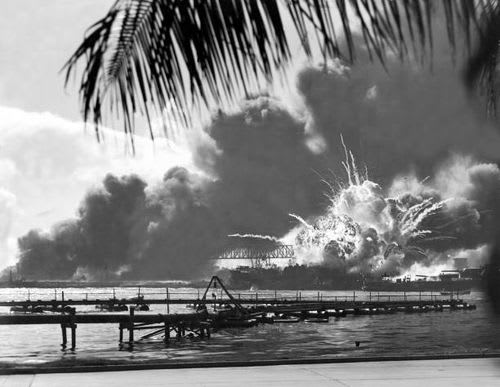
By 1941, that buildup was complete.
And Japan struck first.
But Amelia Earhart may have been the first casualty of that war — four years before it began.
My Final Assessment
After analyzing the declassified documents, the flight path, the transmissions, the geopolitical context, and the deliberate silence from both governments…
My conclusion is straightforward:
Amelia Earhart was likely spying on Japanese militarization in the Mandate Islands, was detected, and was shot down by the Japanese military.
The U.S. covered it up because it could not risk war with Japan in 1937.
All of the evidence — official, circumstantial, geographic, military, and historical — supports this.
All of the contradictions, silences, denials, and absurdities in the official story point toward it.
Earhart did not vanish.
She was erased.
Not by the ocean —
but by geopolitics.
