

Between 2020 and 2024, the United States experienced more than a migration surge or a spike in drug trafficking. What unfolded was the quiet relocation of entire transnational criminal operating systems into American territory. This period marked a structural shift in how foreign criminal and proxy networks interact with the United States, transforming the southern border from a trafficking boundary into a strategic penetration corridor.
At the center of this transformation stand two dominant organizations: the Sinaloa Cartel and the Jalisco New Generation Cartel (CJNG). These groups no longer resemble conventional drug gangs. Over the past decade they have evolved into vertically integrated enterprises controlling chemical procurement, synthetic drug manufacturing, human smuggling routes, weapons pipelines, money laundering infrastructure, and interior distribution networks across major U.S. cities.
By the early 2020s, both organizations functioned as hybrid criminal-paramilitary systems.
This distinction matters, because it reframes the entire border debate. The United States was not merely receiving narcotics. It was absorbing foreign logistics architectures.
When COVID disrupted border enforcement, court systems, and detention capacity in 2020, cartel networks adapted faster than governments. Large shipments gave way to distributed micro-logistics. Smaller loads moved more frequently through commercial trucking, parcel services, private vehicles, and ride-share couriers. Interior stash houses replaced border handoffs. By 2022, cartel command nodes had quietly formed in:
-
Phoenix
-
Dallas
-
Houston
-
Atlanta
-
Chicago
-
Los Angeles
-
New York
Each hub typically contained transportation coordinators, money handlers, enforcement proxies operating through local gangs, and multiple storage locations.
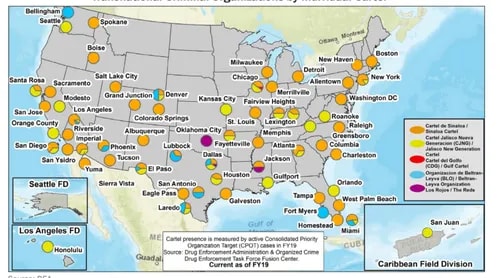
The Drug Enforcement Administration has repeatedly assessed that Mexican transnational criminal organizations now control nearly the entire illicit fentanyl supply entering the United States. Street dealers became disposable retail outlets, while wholesale control remained firmly cartel-owned.
Fentanyl fundamentally altered the economics of crime. Synthetic opioids eliminated agriculture entirely. No poppy fields were required, no seasonal cycles constrained production, and no farmers were needed. Instead, precursor chemicals, pill presses, and warehouse laboratories enabled industrialized manufacturing. A single backpack could now represent millions of dollars in revenue. This chemical scalability allowed cartels to expand geographically at unprecedented speed while remaining insulated from retail-level law enforcement pressure.
At the same time, massive migration flows began moving north from Venezuela and Central America through the Darién Gap and into Mexico. These movements were driven by economic collapse, political instability, and violence. However, they also created ideal operational cover. Cartels increasingly managed these corridors, embedding couriers within migrant groups, coercing vulnerable migrants into forced transport or stash-house labor, and controlling key shelters and transit routes. Migration infrastructure became smuggling infrastructure.
By 2023, cartels no longer treated the United States as a destination market. They treated it as operating territory.
Venezuela, Foreign Proxies, and the Expansion of Risk Vectors
This period also coincided with growing concern among security analysts regarding Venezuela’s role as a permissive environment for transnational crime and foreign proxy activity. For more than a decade, Venezuela has maintained documented relationships with Iranian state actors and Hezbollah-linked networks. Research dating back to congressional studies in 2012 described cooperation between Venezuela’s military and Iran’s Islamic Revolutionary Guard Corps, along with Hezbollah and Hamas establishing operational footholds in the country.
Congressional Hearing Feb 16 2012 – IRAN’S INFLUENCE AND ACTIVITY IN LATIN AMERICA
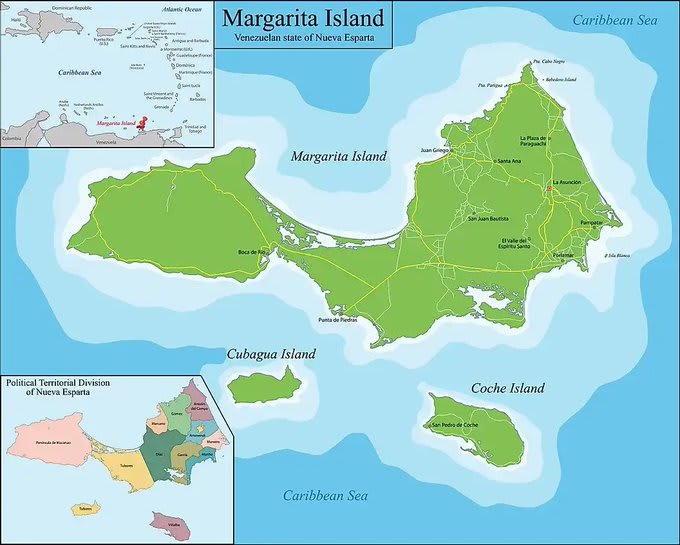
Margarita Island, in particular, has been repeatedly cited in intelligence reporting and academic research as a hub where Hezbollah, Hamas, and Iranian elements operated alongside criminal enterprises. These relationships provided access to fraudulent identity systems, financial laundering channels, and covert travel pipelines.
During the 2020–2024 migration surge, Venezuela became a primary origin point for large numbers of migrants moving north through cartel-controlled corridors.
Former homeland security intelligence analyst
Todd Bensman testified before Congress multiple times on this issue
, most recently in 2023, warning that individuals from terror-linked regions were entering through the southern border and that Hezbollah-associated operatives tied to external operations units had historically used U.S. immigration systems to embed inside American communities.
Here is a post where I break this down from an assessment of OSINT & Congressional Testimony
What is documented is that individuals on terrorism watchlists were encountered at the border, that Hezbollah has maintained sleeper infrastructure in the Western Hemisphere for decades, and that Venezuela provided a permissive environment for Iranian proxy activity. In intelligence analysis, capability vectors matter as much as confirmed attacks.
At the same time, Venezuela’s criminal ecosystem expanded. Under Nicolás Maduro,
. U.S. law enforcement assessments indicate that early waves included trained leadership elements followed by thousands more affiliates. These networks rapidly integrated into existing smuggling systems, reinforcing cartel logistics inside U.S. cities.
Parallel concerns emerged over large numbers of military-aged males arriving from China through the southern border, particularly in Arizona and California. While most migrants were undoubtedly economic refugees, intelligence professionals have consistently warned that mass migration provides cover for adversarial states to insert operatives alongside civilian populations.
The Hybrid Threat to U.S. Cities
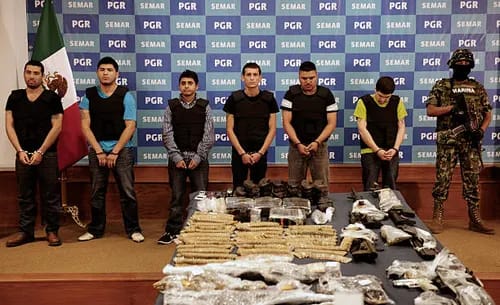
By the end of 2024, the United States faced a fundamentally altered security environment. Cartel distribution hubs existed inside major metropolitan areas. Venezuelan criminal networks had embedded alongside them. Foreign nationals from hostile regions had entered through overwhelmed screening systems. Human trafficking, fentanyl distribution, and money laundering were all being managed through the same corridors.
This convergence creates what security analysts describe as a hybrid threat environment. Not invasion. Insertion.
CJNG in particular operates openly as a paramilitary organization in Mexico, employing armored convoys, coordinated assaults, drone explosives, and military-grade intimidation tactics. When such groups embed logistics inside U.S. cities through gang partnerships and stash-house networks, they become latent force multipliers during moments of domestic instability.
This does not require ideology. It requires chaos.
Any future crisis — economic shock, infrastructure disruption, or large-scale civil unrest — provides operational cover for criminal-paramilitary actors already positioned inside American communities. This model mirrors destabilization frameworks observed globally, where organic protests are amplified, violence is selectively injected, and governance legitimacy erodes.
When we look at recent years of civic upheaval in the United States — from the intense street activity in Seattle and Minneapolis during the summer of 2020 to the nationwide anti-ICE demonstrations that erupted in Minnesota and beyond in early 2026 — a pattern of highly coordinated, networked protest activity becomes clear.
In Minneapolis alone, tens of thousands took to the streets to oppose expanded federal immigration enforcement under “Operation Metro Surge,” and organized coalitions of community groups, unions, and student organizations called for general strikes and nationwide action in response to federal immigration enforcement.
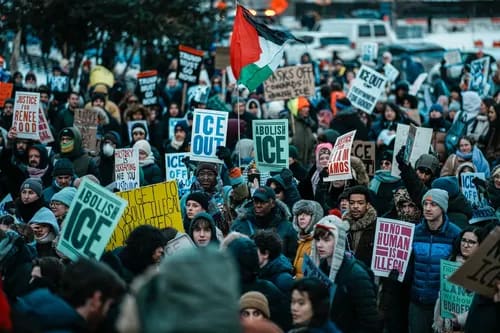
These events were not isolated moments of spontaneous crowding but were accompanied by digital signaling, rapid communications across encrypted apps, organized playbooks and coordination with State and Local political leadership, and mobilizations that drew attention nationwide. Local observers described how protest organizers, neighborhood groups, and activist networks were able to sustain demonstrations, call for extended actions, and coordinate across multiple cities, a scale of organization that in some cases mirrored the logistical networks seen in global movements such as the Arab Spring or other sustained civil resistance campaigns.
When strategic analysts look at these mobilizations alongside the long-range shifts in border exploitation and criminal network penetration, a deeper concern emerges. Mass protests, especially when amplified by foreign or domestic funding channels — whether from NGOs, advocacy groups, or politically aligned donors — can create a foundational layer of social mobilization that adversaries could theoretically exploit.
When such movements exhibit cross-regional connectivity, encrypted command-and-control dynamics, and the ability to sustain rapid, real-time responses to federal operations, they resemble the organizational skeleton of what political scientists refer to as a “color revolution” foundation — a distributed network of actors, communications, and mobilized constituencies capable of generating prolonged disruptive pressure against state institutions. In 2020, such networks coalesced around racial justice and policing issues; by 2026, similar networked structures were evident in anti-federal enforcement activism across multiple metropolitan areas.
Analysts in media reporting have even noted how activist rapid-response groups used encrypted communications and coordinated alerts that resemble insurgency tactical frameworks,
even if rooted in domestic political protest rather than armed rebellion.
The reason this matters in the context of broader national security is not that mainstream civic activism is inherently dangerous — it is not — but that the broader security environment has changed. With transnational criminal organizations embedding logistics, finance, and personnel into the United States; with migration corridors increasingly exploited by sophisticated smuggling networks; and with documented cases of individuals on terrorism watchlists encountered at the southern border, the risk landscape now includes multiple layers of organized network activity that can interact, reinforce, or amplify one another under certain conditions (even if unintentionally).
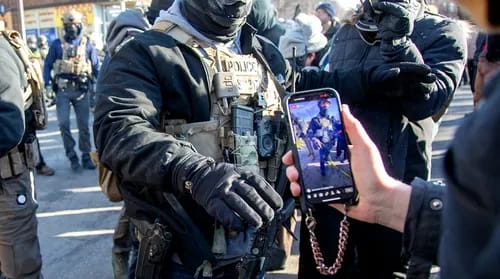
When protest infrastructures — capable of rapid mobilization, digital coordination, and broad social reach — overlap with latent networks of paramilitary actors, foreign proxy vectors, or criminal logisticians, the potential for coordinated destabilization becomes less a hypothetical and more a matter of strategic concern. This kind of hybrid threat scenario, where civic dissent, criminal insertion, and foreign influence vectors intersect, poses a more complex challenge to national cohesion and public order than any single isolated movement.
The central mistake in U.S. border policy from 2020 through 2024 was treating this crisis as a domestic enforcement problem rather than a transnational asymmetric threat ecosystem.
The central mistake in U.S. border policy from 2020 through 2024 was treating this crisis as a domestic enforcement problem rather than a transnational asymmetric threat ecosystem.
The United States has attempted to defend itself at the endpoint of criminal supply chains while leaving the origin nodes largely intact.
That approach cannot succeed.
The Department of Homeland Security and U.S. Customs authorities have reported record fentanyl seizures in recent years, but seizures do not dismantle organizations. They merely raise operating costs, which cartels pass downstream to addicts. Meanwhile, laboratories in Sinaloa and Jalisco continue producing, ports like Manzanillo continue receiving precursor chemicals, leadership structures remain protected by corruption and intimidation, and financial networks remain intact.
America is fighting symptoms.
Mexico contains the disease.
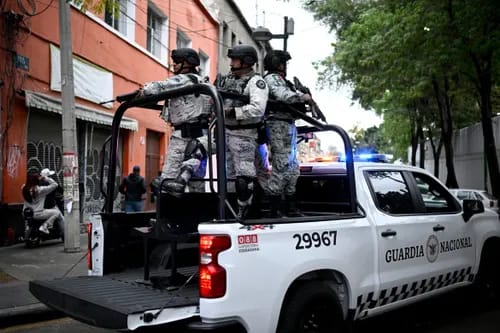
Every major threat vector discussed in this investigation converges south of the border: fentanyl synthesis, migrant corridor control, weapons flows, cartel paramilitary training, financial laundering, and foreign proxy facilitation. Without direct operational pressure on Mexican territory, the United States cannot meaningfully disrupt human trafficking, drug trafficking, arms smuggling, or hostile foreign infiltration.
This is not a sovereignty debate. It is a shared security domain.
Cartels erased the functional border long ago. Policy has simply failed to catch up.
The Venezuela–cartel nexus makes upstream action even more urgent. Migrant flows originating in Venezuela traveled through cartel-controlled Mexican corridors between 2020 and 2024. These same networks facilitating fentanyl shipments were capable of facilitating the movement of criminal recruits, trafficked victims, foreign intelligence assets, and radicalized operatives. Once across the border, cartel infrastructure enabled rapid interior distribution into U.S. cities.
Mexico became the last controllable chokepoint.
Failing to dismantle cartel logistics inside Mexico effectively guaranteed interior infiltration.
Real U.S. involvement must therefore go far beyond symbolic cooperation. It requires persistent joint intelligence command targeting cartel leadership, chemical brokers, financial controllers, and transport coordinators. It demands port security operations focused on precursor chemical interdiction. It requires aggressive financial warfare using Treasury authorities to seize assets, collapse shell companies, and dismantle trade-based laundering schemes. It necessitates leadership neutralization rather than endless street-level arrests. It also requires corridor denial operations treating human smuggling routes as terror-adjacent logistics pipelines.
Most importantly, it requires acknowledging that cartel organizations are no longer merely criminal enterprises.
They are hybrid criminal-paramilitary systems embedded across the hemisphere.
Strategic Reframing Under the 2025 National Security Doctrine and 2026 National Defense Doctrine
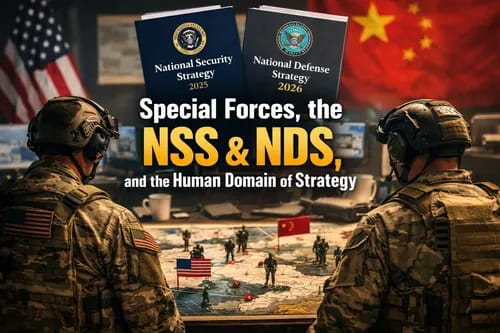
From 2020 to 2024, the United States did not merely confront elevated migration flows or an increase in narcotics trafficking. It experienced the absorption of parallel criminal, smuggling, and proxy infrastructures into its interior. Transnational cartel organizations extended operational nodes into major metropolitan areas. Venezuelan criminal networks embedded alongside existing distribution systems. Screening systems at the border were strained under historic volumes, creating vulnerabilities within vetting and processing mechanisms. Human trafficking, fentanyl production and distribution, weapons flows, and financial laundering converged into a single interconnected transnational ecosystem.
The 2025 National Security Strategy reframes this development not as a conventional immigration matter, but as a hemispheric security challenge. In this framework, border security is no longer treated as an administrative or humanitarian management issue alone. It is recognized as a component of sovereignty defense, supply-chain security, counter-terror infrastructure protection, and domestic stability preservation. The doctrine emphasizes that persistent transnational criminal penetration erodes national resilience in the same way state-sponsored subversion does, particularly when criminal networks develop paramilitary capabilities and financial autonomy that rival local governance capacity in certain regions.
The 2026 National Defense Strategy builds on this assessment by expanding the definition of defense beyond traditional interstate warfare. Under this posture, hybrid threat ecosystems — combining criminal networks, smuggling corridors, foreign proxy access points, cyber and financial penetration, and exploitation of civil unrest — are treated as components of the national defense environment. The doctrine asserts that hostile actors need not deploy conventional military forces to destabilize a nation; they can instead leverage existing illicit infrastructures, economic vulnerabilities, and social fractures.
Within this framework, the destabilization of cartel networks in Mexico and across Latin America is not categorized as foreign intervention policy. It is defined as upstream homeland defense. The strategic logic is straightforward: reactive enforcement at the U.S. border addresses symptoms, but upstream disruption addresses production, logistics, and command architecture. Every fentanyl shipment originates in production labs outside U.S. territory. Human trafficking routes are managed through cartel-controlled corridors south of the border. Financial pipelines that sustain these networks move through offshore laundering systems and shell companies before penetrating U.S. markets.
The 2025 doctrines therefore prioritizes integrated hemispheric counter-network operations. This includes expanded intelligence coordination with Mexico, maritime interdiction of precursor chemicals, financial sanctions targeting laundering nodes, designation of major cartels as foreign terrorist organizations under expanded statutory authorities, and joint task forces aimed at leadership disruption rather than retail-level arrests.
The 2026 defense framework further integrates homeland defense with continental security, treating cartel logistics corridors as potential vectors that could be exploited by adversarial state or non-state actors during periods of domestic instability. The assessment underpinning this doctrine is not that criminal organizations are currently executing coordinated insurgency campaigns within U.S. cities. Rather, it recognizes that once criminal-paramilitary infrastructure becomes normalized inside urban centers, it creates latent capacity that could be leveraged during geopolitical crises, civil unrest, or foreign conflict escalation.
Under this strategic lens, preserving sovereignty requires denying adversaries and criminal enterprises the ability to embed durable infrastructure within U.S. territory. If such networks mature unchecked, the cost of dismantling them increases exponentially over time, both financially and politically.
The window for decisive upstream disruption is therefore framed as time-sensitive. The longer criminal-paramilitary ecosystems consolidate in Mexico and extend operational nodes northward, the more entrenched and resilient they become. By the time such networks are fully normalized within American cities, regaining full control becomes substantially more difficult and resource-intensive.
Accordingly, the guiding principle of the 2025–2026 strategic posture is that cartel disruption in Mexico is not peripheral diplomacy. It is homeland defense executed at the source.
SOURCES:
https://www.securefreesociety.org/research/weaponized-chaos/
https://cis.org/Bensman/Insights-Giving-and-Watching-Congressional-Testimony
https://www.govinfo.gov/content/pkg/CHRG-112shrg73922/html/CHRG-112shrg73922.htm
https://www.foxnews.com/politics/far-left-network-helped-put-alex-pretti-harms-way-made-him-martyr
https://www.whitehouse.gov/wp-content/uploads/2025/12/2025-National-Security-Strategy.pdf
https://news.usni.org/2026/01/24/2026-u-s-national-defense-strategy
