

There is a fundamental problem in how most people approach health—and it’s not because they lack effort. It’s because they are operating inside a model that is inherently reactive.
We wait until something breaks.
We wait until energy drops, recovery slows, inflammation builds, or cognitive clarity begins to fade. And then, once those symptoms become noticeable enough, we look for solutions.
But by that point, we are already downstream of the problem.
The real leverage point has always been upstream—at the level of cellular function, regeneration, and the body’s inherent ability to repair itself.
That’s what makes the conversation around LifeWave’s X39 system worth paying attention to. Not because it is positioned as a “product,” but because it represents a shift in how we think about health entirely.

The Decline Nobody Talks About
There is a quiet, measurable trend that happens inside every human body as it ages: the steady decline of stem cell activity.
This is not theoretical. It is well documented.
Stem cells are responsible for repair, regeneration, and maintaining the integrity of tissues throughout the body. They are the foundation of recovery, resilience, and biological efficiency. When you are young, this system operates at a high level. Injuries heal faster. Energy is more stable. Adaptation is quicker.
But over time, that system begins to degrade.
By around age sixty, stem cell activity has declined by more than half. In many cases, significantly more.
What follows is what most people interpret as “normal aging.” Slower recovery becomes expected. Chronic inflammation becomes tolerated. Brain fog is brushed off. Energy becomes inconsistent. And over time, the baseline shifts downward.
The key insight here is that these symptoms are not isolated issues. They are downstream effects of a deeper biological slowdown.
And that raises a critical question:
If the decline is rooted at the cellular level, then why are most solutions focused on surface-level symptoms?
Learn about LifeWave’s Regenerative Technology
Join Zoom Meeting
11am EST/10am CT
Saturday, March 20, 2026
(Scroll to bottom of page after you click link)
A Different Entry Point: Photobiomodulation
The approach behind X39 is not to override the body. It is to signal it.
At its core, X39 is a phototherapy patch. There are no drugs, no injections, no external chemical inputs. Instead, it operates through a process known as photobiomodulation.
This is where things become interesting.
The human body emits light. It also responds to light. This is not fringe science—it is well established in fields studying cellular communication and mitochondrial function.
What X39 does is reflect specific wavelengths of light back into the skin. That interaction triggers a cascade of biochemical responses. Among those responses is the elevation of a copper peptide associated with stem cell activation.
The mechanism is subtle, but the implications are significant.
Instead of introducing something foreign into the body, the system is designed to stimulate processes that already exist. It is, in a sense, a signaling technology—one that nudges the body back toward a more optimal state of function.
This distinction matters.
Because once you move from “input-based” health (supplements, pharmaceuticals, external compounds) to “signal-based” health, you are no longer forcing outcomes. You are facilitating them.
Why Most People Get This Wrong
Even when people encounter something that has potential, they often misapply it.
They treat it casually.
They try it for a few days, maybe a couple of weeks, and then make a judgment. If the result is not immediate or dramatic, they move on.
This pattern is one of the biggest obstacles to understanding anything that operates at the cellular level.
Biology does not respond instantly to subtle signals. It adapts over time.
Which is why the protocol recommended by the inventor becomes one of the most important aspects of the entire system:
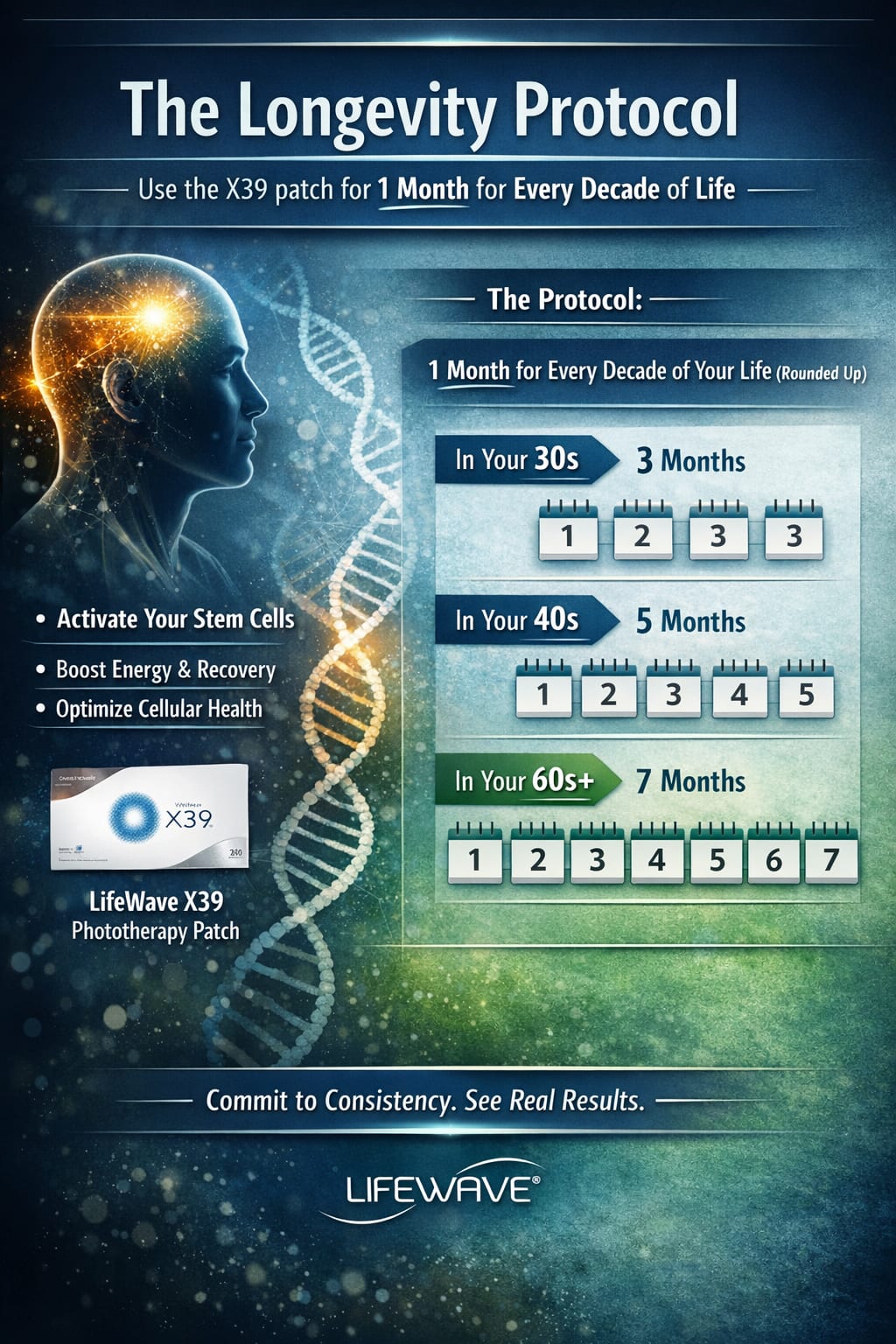
One month of use for every decade of life, rounded up.
A 30-year-old would follow a three-month protocol.
A 45-year-old would commit to five months.
A 62-year-old would run a seven-month cycle.
This reframes the entire conversation.
It is no longer about “trying a product.”
It is about running a protocol.
And that distinction separates curiosity from results.
Consistency as a Force Multiplier
When you begin to look at this through the lens of consistency, a pattern emerges.
The body does not change because of a single input. It changes because of repeated signals over time.
Every day that a system is activated, the body receives a reminder. A nudge. A direction.
Over weeks and months, those signals compound.
This is why inconsistency destroys results. Not because the system doesn’t work, but because the signal is interrupted before adaptation can occur.
It is also why structure becomes critical.
If someone is going to follow a multi-month protocol, the logistics of how they approach it matter more than they realize. Gaps in usage, inconsistent access, or cost inefficiencies all introduce friction—and friction is the enemy of consistency.
This is where the Preferred Customer and Preferred Plus model comes into play.
Not as a business opportunity, but as a structural advantage.
It allows individuals to maintain continuity without having to constantly make new decisions or pay higher one-off costs. It aligns the system with the protocol.
And when the structure supports the behavior, the probability of following through increases dramatically.
What People Are Actually Experiencing
Across conversations, testimonials, and observations, the outcomes people describe tend to cluster around a few core areas.
Energy becomes more stable. Not necessarily in a sudden spike, but in a more sustained, consistent way.
Recovery improves. Whether from physical exertion, injury, or general wear and tear, the body appears to respond more efficiently.
Inflammation decreases. Subtle at first, but noticeable over time.
Cognitive clarity sharpens. Focus improves. Mental fatigue becomes less pronounced.
Individually, these might seem like separate benefits. But when viewed together, they point to something deeper: an improvement in overall cellular performance.
Which brings us back to the original premise.
If the body is functioning more efficiently at the cellular level, then everything built on top of that foundation begins to improve as well.
A Shift in Perspective
What makes this worth paying attention to is not just the technology itself, but what it represents.
It is part of a broader shift away from reactive health and toward regenerative optimization.
Instead of asking, “How do I fix this problem?”
The question becomes, “How do I improve the system so the problem doesn’t arise in the first place?”
This is a fundamentally different way of thinking.
It requires patience. It requires consistency. It requires a willingness to move beyond quick fixes and into structured protocols.
But it also aligns more closely with how the body actually works.
The Real Decision Point
For anyone who has already explored the conversation, watched the interview, or looked into the science, the next step is not about gathering more information.
It is about making a decision.
Not whether something sounds interesting.
But whether it is worth testing properly.
There is a difference between casually experimenting with something and fully engaging with it.
One produces opinions.
The other produces data.
And in a space like this, where outcomes are cumulative and time-dependent, that difference matters.
Final Thought
There is a growing recognition that the future of health will not be built on more intervention, but on better optimization.
Technologies that work with the body instead of against it.
Systems that signal rather than override.
Protocols that emphasize consistency over intensity.
X39 sits inside that emerging category.
Whether someone chooses to explore it or not is ultimately personal.
But the framework it introduces—cellular focus, signal-based interaction, and structured consistency—is something far broader.
It is a glimpse into where health is going.
And for those willing to engage with it correctly, it raises a simple but powerful question:
What happens when you give the body the right signals… long enough for it to respond?
